The Smart Forests workshop, Cairo, Egypt, 2023
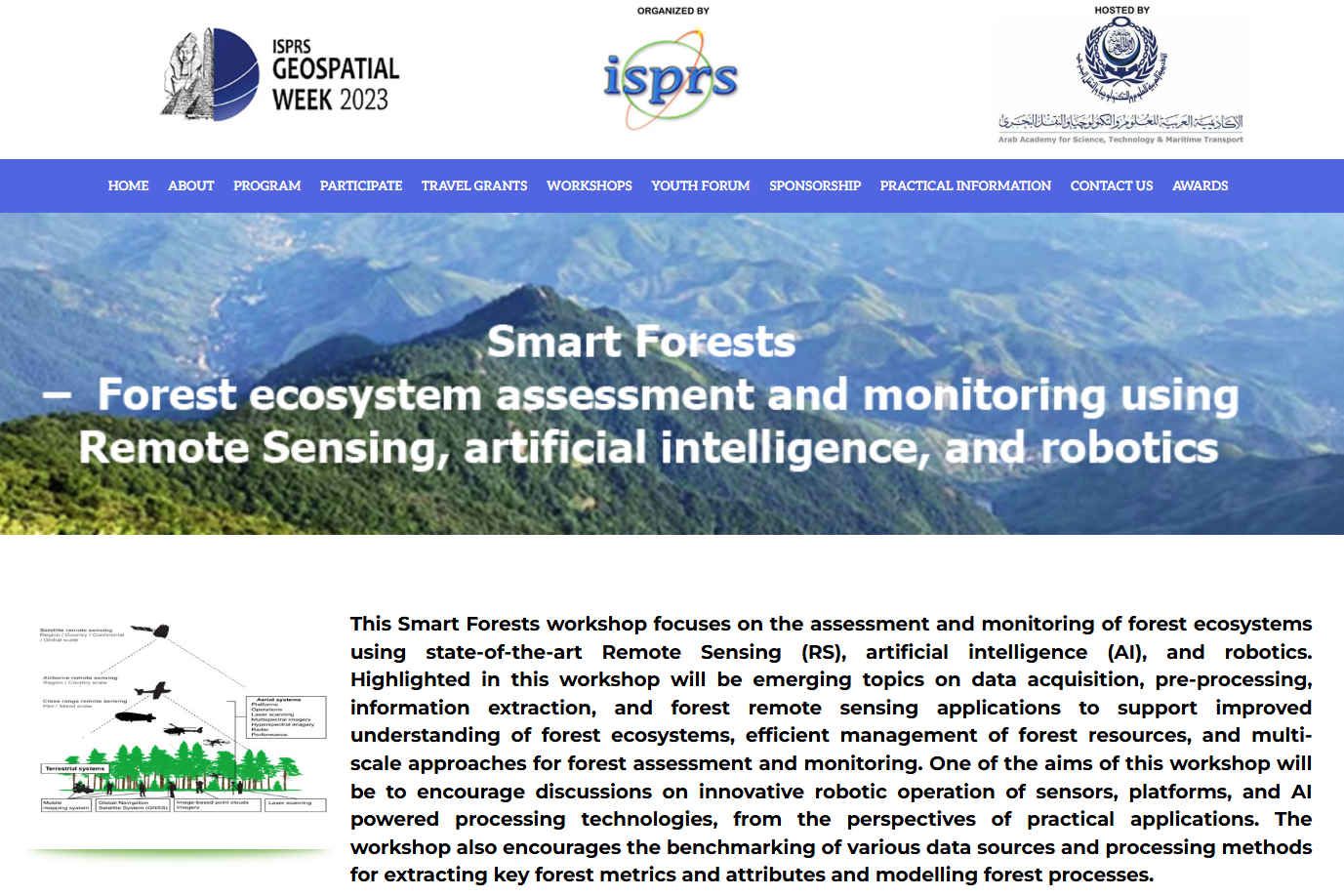
The 1st Smart Forests workshop is held in Cairo, Egypt, Sep. 5 - 7th, 2023. This workshop hosts five sessions including large-scale forest monitoring using deep learning, multi-scale systems and methods, agricultural and forestry monitoring and assessment, close-range remote sensing sensors and solutions, and individual tree-scale modeling and analysis. These presentations showcase the latest developments in data acquisition, preprocessing, information extraction, and applications of forest remote sensing. Experts, e.g., from China, the United States, Finland, Italy, Germany, Switzerland, and Chile, present and discuss topics such as intelligent remote sensing deep learning frameworks and model design, precision of ICESAT-2 ATL08 satellite-borne laser data, high spatiotemporal resolution monitoring of birch tree growth dynamics, deep learning-based satellite forest monitoring, sensing and data analysis technology promoting digital forestry, GPT applications in forestry exploration. These discussions will provide theoretical and technical support for further research developments
The 1st Smart Forests workshop is co-organized by the International Society of Photogrammetry and Remote Sensing (ISPRS) working groups Remote Sensing Data Processing and Understanding (WGIII-1), Data Quality and Benchmark of Sensors (WGI-7), and Remote Sensing of Agricultural and Nature Ecosystems (WGIII-8).
This workshop has three Keynote Presentations from internationally renowned scholars:
- Jianya Gong -- A Special Deep Learning Framework and Foundation Model for Intelligent Interpretation of Remote Sensing
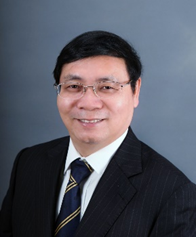
Dr. Jianya Gong is a professor of Wuhan University and an academician of Chinese Academy of Sciences. He is the winner of the National Outstanding Youth Fund, the distinguished Professor of "Changjiang Scholars" of the Ministry of Education, the chief scientist of the 973 Project, the academic leader of the Innovation Group of the National Natural Science Foundation, the leading scientific and technological talents of the State Bureau of Surveying and Mapping, and the convenor of the Surveying and Mapping Discipline Group of the sixth and Seventh Subject Review Groups of The State Council. He was the director of the State Key Laboratory of Information Engineering in Surveying, Mapping and Remote Sensing and the Dean of the school of Remote Sensing Information Engineering of Wuhan University, president of the Commission VI of the International Society of Photogrammetry and Remote Sensing, and president of International Association of Chinese Professional in Geographic Information Science. He is currently the Secretary-General of the Asian Association for Geographic Information Systems, associate editor of Acta Geodaetica et Cartographica Sinica and Editor-in-Chief of Journal of Geodesy and GeoInformation Science.
Dr. Jianya Gong is mainly engaged in the research of remote sensing and geographic information system. He has undertaken more than 40 national and provincial scientific research projects. He has published 13 monographs and textbooks, and more than 500 papers. He has won the National Science and Technology Innovation Team Award once, the first prize once and the second prize for 4 times of the National Science and Technology Progress Award, the provincial and ministerial level special prize for 3 times and the first prize for 7 times, and the Dolezal Achievement Award of the International Society of Photogrammetry and Remote Sensing.
Abstract:Artificial intelligence has been rapidly developed and widely applied in many fields. Important research progress has also been made in intelligent interpretation of remote sensing images, and some scenarios have been applied. However, the large-scale business application of intelligent interpretation of remote sensing images is not mature enough. The report analyzes the existing problems in intelligent interpretation of remote sensing, including the small number of samples, incomplete categories, lack of standards and specifications, and the existing deep learning network framework is difficult to meet the needs of intelligent interpretation of multi-source remote sensing images. The speaker introduced his team's latest research achievements in remote sensing intelligent interpretation, including the design and research progress of LuojiaSET, a diversified and standardized sample set, and LuojiaNET, a dedicated deep learning network framework for remote sensing intelligent interpretation, as well as the foundation model based on LuojiaNET and its applications in remote sensing intelligent interpretation.
- Christian Heipke -- Forest monitoring from space using deep learning

Dr. Christian Heipke is a professor of photogrammetry and remote sensing at Leibniz Universität Hannover, where he currently leads a group of about 25 researchers. His professional interests comprise all aspects of photogrammetry, remote sensing, image understanding and their connection to computer vision and GIS. His has authored or co-authored close to 500 scientific papers, more than 100 of which appeared in peer-reviewed international journals. He also supervised more than 40 PhD candidates as main supervisor.
He is the recipient of the 1992 Otto von Gruber Award, the 2012 Fred Doyle Award, both from the International Society of Photogrammetry and Remote Sensing (ISPRS), the 2013 Photogrammetric (Fairchild) Award from ASPRS, and the 2022 Albrecht Meydenbauer Medal from DGPF. He is an ordinary member of various learnt societies incl. DGK (German Geodetic Commission), acatech (German Academy for Technical Sciences), IAA (International Academy of Astronautics) and the European Academy of Sciences and Arts.
From 2004 to 2009, he served as vice president of EuroSDR (European Spatial Data Research, formerly known as OEEPE). From 2011-2014 he was chair of the German Geodetic Commission (DGK), from 2012-2016 ISPRS Secretary General, and from 2016-2022 ISPRS President. Currently he serves as ISPRS Past President.
Abstract:Currently, a pressing issue is the rapid provision of up-to-date and comprehensive spatial information for making optimal management decisions in the forestry industry. Remote sensing data represents a most effective tool for addressing many tasks in this field. The development is characterized by a rapid increase in the number of operating satellites and the simultaneous increase in spatial and temporal resolution, leading to a large increase in data volume. On the one hand, this development allows for a significant expansion of the range of tasks to be solved, including forest monitoring; on the other hand, there is a need to develop new algorithms that ensure automated and fast recognition of objects in satellite images.
In this presentation we describe our work within the ForstCARe project. We developed a Copernicus-based forest management assistance system using innovative AI procedures. It supports rapid detection of illegal clearings, monitoring of climate-related forest damage (due to drought, storm, or pest calamity) and monitoring management measures for reforestation in accordance with the need for rapid processing of large amounts of data.
Rapid provision and analysis of data is essential to provide timely results, on the basis of which illegal clearings can be stopped or pest-infested stands removed as quickly as possible. AI procedures are designed to remove the two main obstacles to a broad and successful use of Copernicus imagery in this application segment: (a) The lack of representative training data in the needed quantity and quality. (b) The insufficient availability of suitable sensor data due to cloud cover, especially after storms and in the tropics and other regions with frequent cloud cover.
- Prof. Songlin Fei & Prof. Ayman Habib -- Sensing and Data Analytics Technologies as Facilitators for Digital Forestry
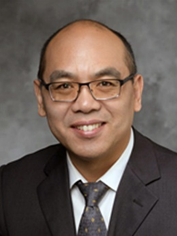
Dr. Songlin Fei is the Professor and Dean’s Chair of Remote Sensing, and serves as the Director of the Institute for Digital Forestry at Purdue University. Dr. Fei’s research includes forest ecology, invasion ecology, and digital forestry. His research has significantly advanced ecology and management of invasive species, the understanding of forest responses to climate change, and modernizing forestry into the digital age. During the past twenty years, Dr. Fei has secured over $54 million grant funding and has published over 140 peer-reviewed research articles. He also serves as the associate Editor in Chief for Ecosphere.
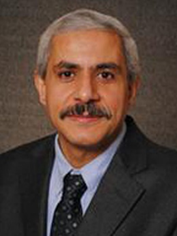
Dr. Ayman Habib is the Thomas A. Page Professor of Civil Engineering. He serves as the Co-Director of the Civil Engineering Center for Applications of UAS for a Sustainable Environment (CE-CAUSE), the Associate Director of the Institute for Digital Forestry, and the Associate Director of the Joint Transportation Research Program at Purdue University. His research interests span terrestrial and aerial mobile mapping systems using imaging and LiDAR remote sensing modalities. The application domains of his work include transportation, infrastructure monitoring, environmental protection, precision agriculture, digital forestry, resource management, and archeology.
Abstract:Digital technology continues to transform industries and our daily lives; however, forestry still operates largely on the basis of fundamentals and manual processes. In this presentation, we discuss how to move the traditional forestry field into the digital age. In this first part of the presentation, we highlight some examples and lessons learned on how to merge digital technology and cross-disciplinary knowledge to revolutionize the forestry sector that has tremendous economic and ecological impacts. We showcase the use of different sensing technology from proximal, near-proximal, aerial, and satellite-based sensing platforms for tree localization, identification, and measurement. In the second part of the presentation, we provide a detailed example of using backpack and UAV based LiDAR mobile mapping systems, along with the application of AI, for individual stem-level inventory. We cover the whole pipeline from data acquisition, registration, integration, and analytics.
WG III/1